Candidate feedback in AI interviews: what hiring teams should measure
Learn why candidate feedback matters in AI interviews, how anonymous ratings and comments work, and how recruiters can use them to improve screening quality.
MyPitch Team ·
Most hiring teams evaluate an AI interview workflow by looking at recruiter outcomes: how many candidates completed the screen, how quickly reports were generated, and whether the hiring manager trusted the recommendation.
Those numbers matter. But they miss one of the most useful signals in the process: what the interview felt like for the candidate.
If candidates find the interview confusing, too rigid, technically unreliable, or unclear about the role, the recruiting team should know that before it becomes a hidden conversion problem. If candidates consistently say the process was clear and fair, that is also evidence. It tells the company that faster screening is not necessarily coming at the cost of candidate experience.
That is why MyPitch collects anonymous post-interview feedback from candidates. After completing an AI interview, a candidate can rate the experience from 1 to 5 and leave an optional comment. Recruiters can then see candidate feedback by role and across the company.
In the early customer feedback we have observed so far, the average candidate interview rating is 4.1 out of 5. That is not a universal benchmark, and it should not be treated as one. It is an early signal that candidates can have a positive experience with AI-led screening when the workflow is short, transparent, and easy to complete.
More importantly, the comments create a feedback loop. They show hiring teams what needs to improve.
The short answer: treat feedback as a process signal, not a hiring signal
Candidate feedback should not decide whether someone moves forward. The interview answers, transcript, recording, and recruiter review belong in the candidate evaluation workflow.
The post-interview rating belongs somewhere else: the hiring-process improvement loop.
That distinction makes the metric safer and more useful. A candidate's comment can tell the team that a question was unclear, that the AI froze, that the role context was thin, or that the experience felt professional. Those signals help the company improve the interview without turning candidate satisfaction into a hidden scoring input.
Candidate experience should be measured inside the screening workflow
Candidate experience is often discussed as a brand problem. That framing is too broad to be useful.
For a first-round AI interview, candidate experience becomes operational. The team needs to know:
- Did candidates understand what was happening?
- Could they test their microphone and camera before the interview?
- Did the AI conversation feel natural enough to complete?
- Were questions clear and relevant to the role?
- Did technical issues interrupt the session?
- Did the process leave candidates with enough confidence to continue?
These are not abstract satisfaction questions. They are product and hiring-process questions.
Greenhouse's candidate survey documentation, for example, treats candidate surveys as a way to gauge overall satisfaction and leave space for commentary on improvement. SHRM has also described candidate feedback surveys as a way to understand the application process, communication quality, and interview experience. The common lesson is simple: candidate experience is not something a recruiting team can infer from completion data alone.
A candidate can complete an interview and still leave frustrated. Another candidate can be rejected and still say the process was clear. Without direct feedback, both cases disappear into the same pipeline metrics.
The MyPitch candidate flow captures feedback at the right moment
The MyPitch candidate experience is designed as a short browser-based flow:
- The candidate receives an interview link by email.
- They open the link and review the role context.
- They prepare for the interview and test their device.
- They can try how it feels to speak with the AI interviewer.
- They complete the live AI video interview.
- After the interview, they can rate the experience from 1 to 5.
- They can leave an anonymous written comment.
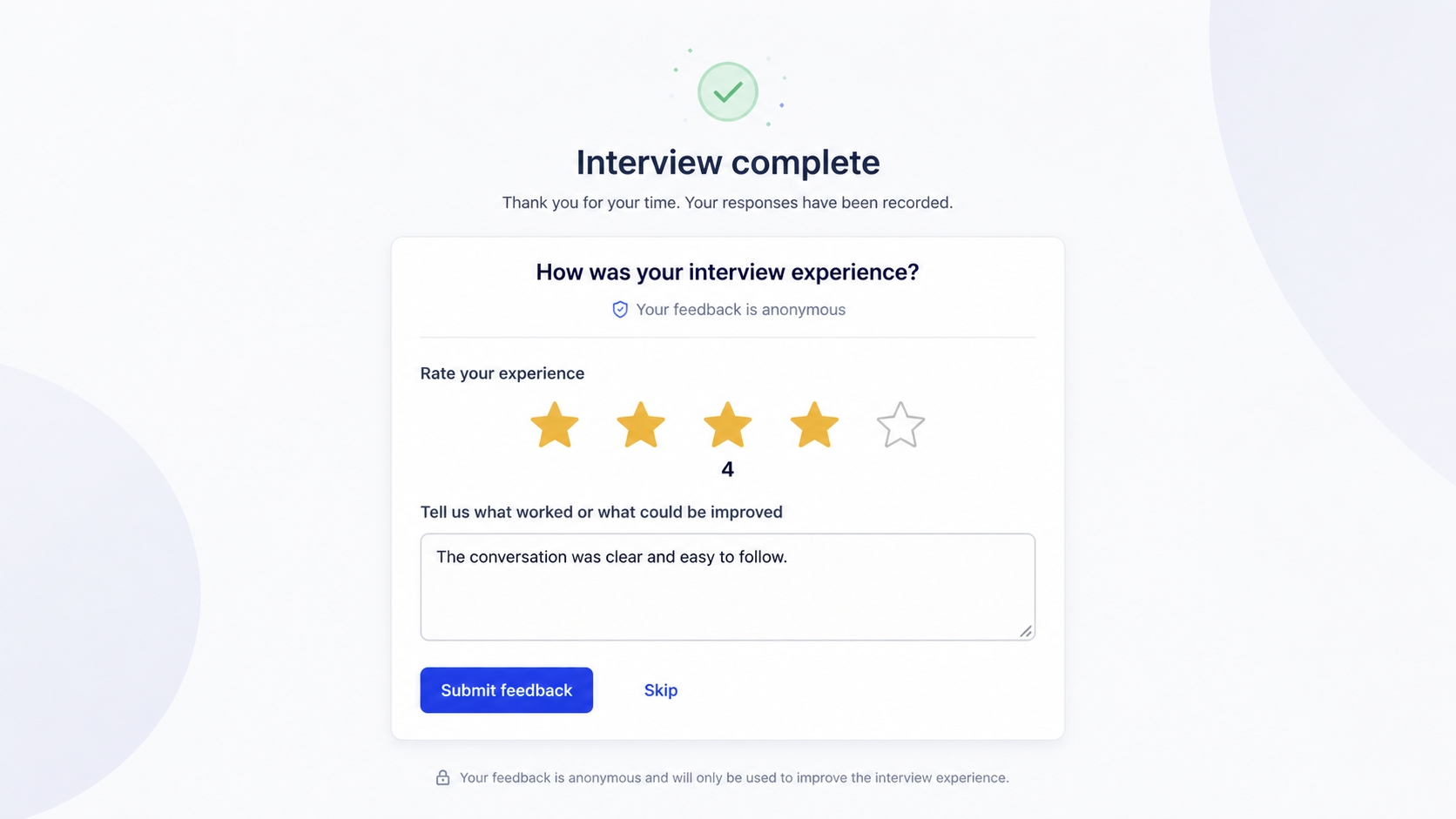
Caption: After the interview, candidates can rate the experience and leave an optional anonymous comment.
This timing matters.
Feedback is collected while the interview is still fresh. The candidate does not need to find a later survey email, remember the details days later, or decide whether it is worth responding after the hiring outcome is known.
It also keeps the feedback separate from the assessment. The candidate's rating is not a hiring signal. It is a process signal for the company.
That distinction is important in AI hiring. MyPitch is designed as an advisory screening layer: candidates complete interviews, recruiters review structured reports, and humans make the hiring decision. Candidate feedback gives the hiring team another human signal, but it improves the process rather than scoring the person.
Recruiters need both the average and the comments
A rating alone is useful, but incomplete.
The average tells the team whether the overall experience is moving in the right direction. The comments explain why.
In MyPitch, recruiters can review anonymous candidate feedback in a dedicated feedback view. The dashboard shows:
- average rating for the selected time window;
- total number of feedback responses;
- candidate feedback rows;
- role names;
- star ratings;
- comments;
- submission dates;
- role filtering.
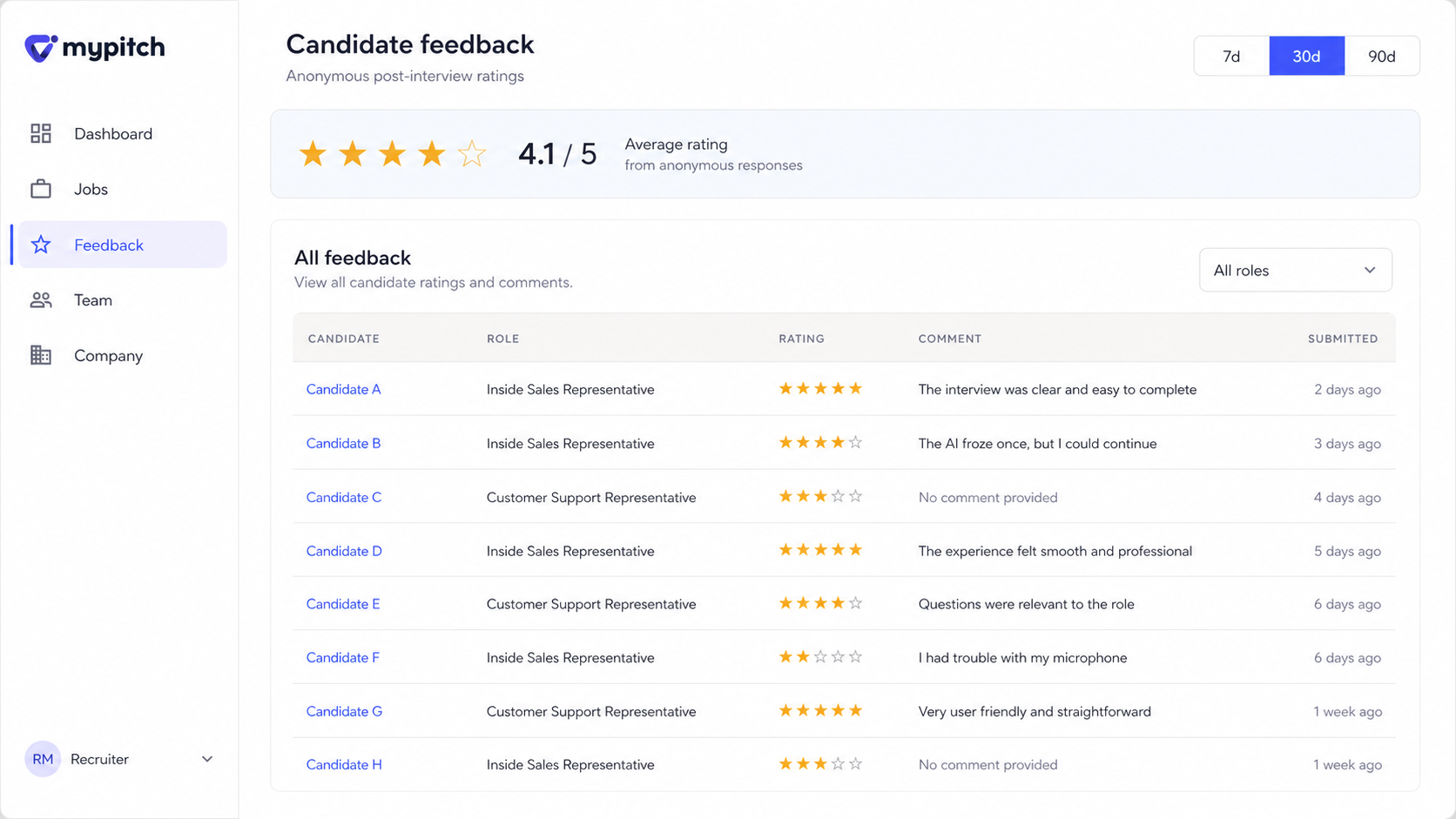
Caption: Recruiters can review anonymized ratings and comments by role, time window, and candidate interview.
This gives the hiring team two levels of visibility.
At the company level, the team can ask: "Are candidates generally comfortable with this interview format?"
At the role level, the team can ask: "Is something about this specific vacancy, question set, or interview flow creating friction?"
That second question is where the product becomes more useful than a static survey. Candidate feedback can point to issues that would otherwise be hard to diagnose from recruiter-side metrics alone.
Comments turn candidate feedback into product and hiring-process learning
The most useful candidate comments usually fall into a few categories.
The strongest feedback is not always positive. A low rating with a specific comment can be more valuable than a five-star rating with no detail.
For example, if several candidates say the AI conversation froze, that is a product reliability issue. If several candidates say the same question felt confusing, the question should be rewritten. If candidates say they did not understand the role, the hiring team may not have a screening problem at all; it may have a vacancy clarity problem.
This is where AI can become useful again after the interview. Over time, candidate comments can be analyzed to answer questions such as:
- Which roles produce the lowest candidate experience ratings?
- Which questions generate confusion or low confidence?
- Which technical issues appear repeatedly?
- Which vacancies need clearer role context?
- Which interview formats produce stronger completion and satisfaction?
The point is not to use AI to explain away candidate frustration. The point is to make patterns visible so the hiring team can fix them.
Candidate feedback protects the employer brand while improving the screen
Speed is only valuable if the hiring team does not damage trust while moving faster.
Candidate experience research consistently points to the same practical problem: candidates remember how the process treats them. Greenhouse's 2024 candidate experience report found that 79% of candidates said they would reapply to a company if they received feedback after an interview, even if they were not offered the job. SHRM has also emphasized that candidate resentment can affect whether people apply again, refer others, or maintain positive brand affinity.
Those findings are broader than AI interviews, but they apply directly to AI screening.
When a company introduces an AI interviewer, candidates need clarity:
- what the AI is doing;
- what the company will review;
- whether a human will make the final decision;
- what happens after the interview.
Anonymous feedback does not solve every trust concern, but it gives the company a way to listen at scale. That matters most when screening volume is high and recruiters cannot personally debrief every candidate.
The metric is useful only if it changes behavior
A candidate feedback rating should not become a vanity metric.
If a company sees a 4.1 / 5 average and does nothing else, it has learned very little. The useful version is a weekly or role-level review:
- Look at average rating by role.
- Read every low-rating comment.
- Separate technical issues from question-design issues.
- Compare feedback to completion rate and report quality.
- Rewrite confusing questions.
- Improve the role intro where candidates lacked context.
- Track whether ratings improve after the change.
The recruiting team is no longer asking, "Did candidates complete the interview?" only.
It can ask, "Did the interview create useful evidence while preserving a candidate experience we would be comfortable scaling?"
Where this breaks
Candidate feedback is useful, but it has limits.
First, not every candidate will leave a comment. The silent majority may have a different experience from the people who respond.
Second, ratings can be influenced by hiring outcome, role excitement, market conditions, or the candidate's personal preference about AI. A low rating does not automatically mean the product failed. A high rating does not automatically mean the process is fair or effective.
Third, comments should not be used as hiring evidence unless the candidate explicitly intended that. In MyPitch, the cleaner mental model is: interview answers support candidate evaluation; post-interview feedback supports process improvement.
Finally, AI hiring workflows operate in a sensitive regulatory and trust environment. In some jurisdictions, automated employment decision tools may trigger notice, audit, or transparency requirements. New York City's Automated Employment Decision Tools page is one example of how candidate notice and transparency have become part of the hiring-technology conversation. Teams should treat candidate disclosure, human review, and process documentation as core parts of the workflow, not optional copy.
What hiring teams should measure next
Candidate feedback becomes most useful when it sits beside operational hiring metrics.
For every role using AI interviews, track:
- invite-to-start rate;
- start-to-completion rate;
- interview completion time;
- report generation success;
- recruiter report view rate;
- candidate feedback rating;
- low-rating reasons;
- candidate comments by theme;
- recruiter agreement or override rate;
- progression to human interview.
This combination shows whether the AI interview is creating value for both sides of the process.
A high completion rate with poor feedback means the company may be pushing candidates through a frustrating process. A good rating with weak reports means the candidate experience works, but the screening evidence needs improvement. A strong rating, strong completion, and recruiter-reviewed reports suggest the workflow may be ready to scale.
That is the standard MyPitch is building toward: not just faster interviews, but a measurable screening loop where recruiters see the evidence and candidates can tell the company how the process felt.
The candidate should not disappear after the AI interview ends. Their experience is part of the hiring system too.
Try it on one role before treating it as a benchmark
The useful way to evaluate candidate feedback is not to debate whether AI interviews are good or bad in general. It is to run a controlled test on one active role.
Pick a role with enough candidate volume, such as inside sales, appointment setter, customer support, or call center. Invite a small candidate batch. Review three things together:
- whether candidates complete the interview;
- whether recruiters trust the reports;
- whether candidate feedback shows the process is clear enough to scale.
If all three signals are healthy, the team has a stronger reason to expand AI screening. If one signal is weak, the feedback tells the team where to fix the workflow before adding more candidates.
That is the real value of candidate feedback in AI interviews: it turns candidate experience from a vague concern into a measurable operating signal.
Feedback signalWhat it can meanWhat the hiring team can inspect"The conversation felt natural"The AI interviewer experience is working for this roleKeep the flow, review report quality"The AI froze" or "my answer was skipped"Technical reliability issueSession logs, reconnect behavior, recording/transcript completeness"The question was unclear"Question design issueRewrite question, add role context, remove ambiguity"I did not understand the role"Vacancy communication issueImprove job description, intro script, or candidate Q&A materials"The interview felt too long"Interview length or pacing issueReduce questions, tighten focus areas"I wanted to speak with a person"Trust or expectation issueImprove disclosure, explain next steps, clarify human review
Related MyPitch resources
- See how AI candidate screening keeps the source evidence available.
- Review an anonymized candidate report example.
- Read the practical controls behind responsible AI screening.