Recruiter Phone Screens: How to Automate First-Round Screening Without Losing Hiring Evidence
Learn how to reduce recruiter phone screens with AI interviews while keeping structured evidence, transcripts, recordings, candidate feedback, and human review.
MyPitch Team ·
A recruiter phone screen is supposed to answer a practical question: should this candidate move to the next step?
In low-volume hiring, that call can work well. A recruiter speaks with the candidate, checks motivation, confirms the basics, listens for communication quality, and decides whether the hiring manager should spend time with them.
The problem starts when the same screen has to happen 30, 50, or 200 times for repeatable roles. Sales development, appointment setter, customer support, call center, client service, and operations coordinator roles all create the same capacity problem: the first screen is important enough to do, but repetitive enough to become a bottleneck.
That is why many hiring teams start looking for ways to automate the recruiter phone screen.
The goal should not be to remove recruiters from the decision. The goal should be to remove repetitive scheduling and questioning while preserving the evidence recruiters need to make a responsible next-step decision.
The difference matters. Bad automation turns a hiring process into a black box. Good automation gives recruiters more structured evidence than a rushed phone screen usually leaves behind.
The short answer: automate the screen, not the hiring decision
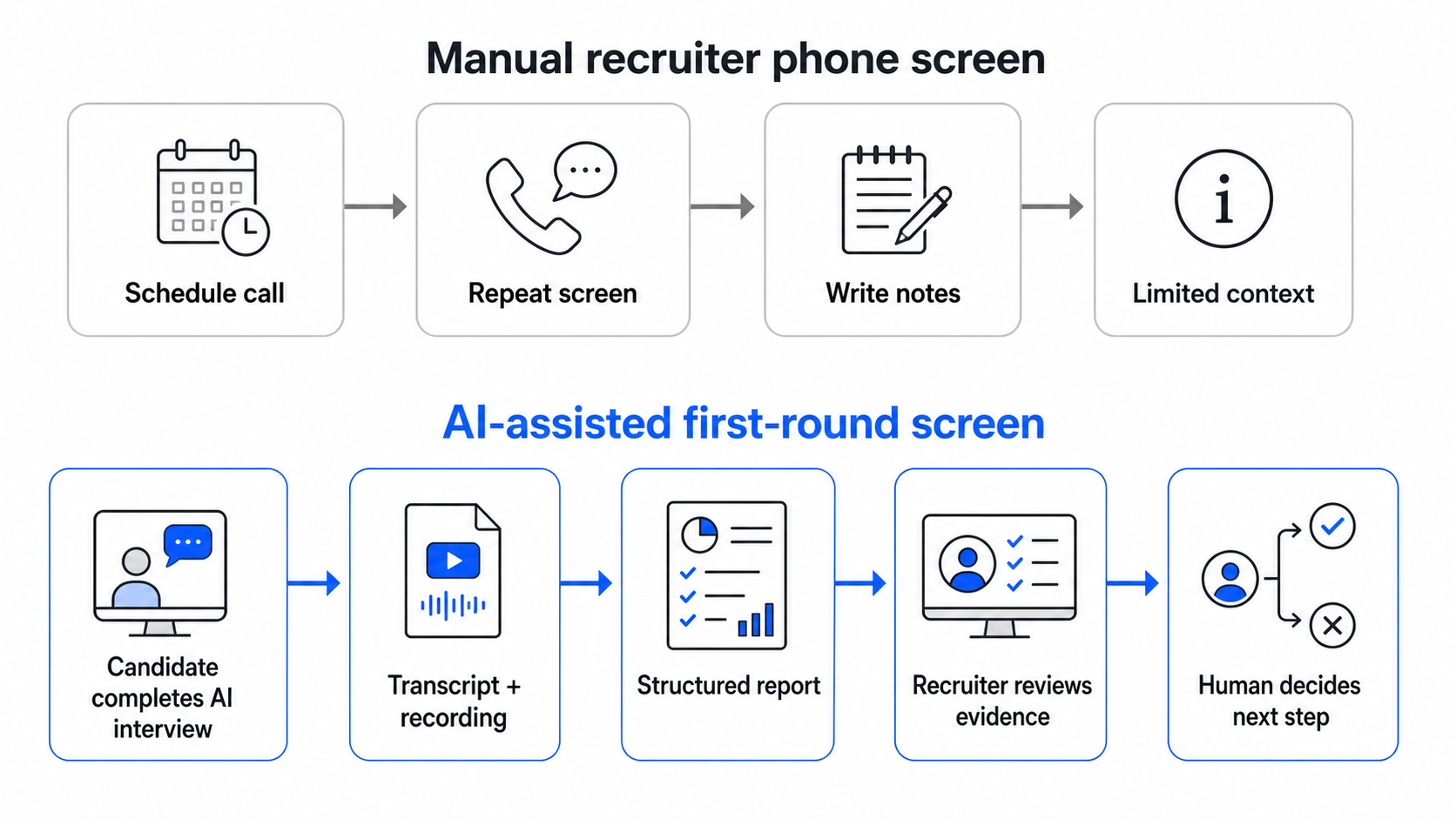
The safest way to think about recruiter phone screen automation is this:
- Let software handle the repetitive first-round interview workflow.
- Let candidates complete the screen on their schedule.
- Preserve the transcript, recording, answers, and structured report.
- Keep humans responsible for the hiring decision.
That model changes the role of the recruiter. Instead of spending the day repeating the same introduction and qualification questions, the recruiter reviews comparable evidence and decides who should move forward.
For high-volume roles, this is the real efficiency gain. The recruiting team is not trying to talk to fewer candidates. It is trying to evaluate more candidates consistently without adding more calendar work.
Recruiter phone screens become expensive because they do not run in parallel
The core limitation of a recruiter phone screen is not the phone. It is the synchronous workflow.
Every screen requires:
- a candidate who is available;
- a recruiter who is available;
- scheduling or back-and-forth messages;
- live call time;
- notes taken during or after the call;
- a decision that may depend on memory, speed, and recruiter workload.
That process is manageable when hiring volume is low. It breaks down when the team needs to screen many similar candidates quickly.
The bottleneck is especially visible in roles where communication matters but the first-round screen is repeatable:
| Role type | Why phone screens pile up | What the team needs from the screen |
|---|---|---|
| SDR / BDR | Many applicants, similar first-round criteria | Communication, motivation, sales judgment, coachability |
| Appointment setter | High-volume funnel, fast hiring needs | Confidence, clarity, objection handling, reliability |
| Customer support | Repetitive screening, high candidate flow | Empathy, written/spoken clarity, problem solving |
| Call center | Volume and turnover create constant hiring | Voice presence, patience, scenario judgment |
| Staffing agency roles | Agencies must screen many candidates across clients | Shareable evidence, consistent notes, faster shortlists |
In each case, the phone screen has value. The issue is that the value is trapped inside a live conversation that can happen only one candidate at a time.
The useful output is not a call. It is hiring evidence
Most teams describe the first screen as a call because that is the activity they see. But the business value is not the call itself.
The business value is the evidence the call produces:
- Did the candidate understand the role?
- Can they communicate clearly?
- Did they give concrete examples?
- Are there obvious gaps or risks?
- Should a hiring manager spend time with them?
- What should the next interviewer verify?
If the recruiter phone screen ends with only a few notes in an ATS, much of that evidence disappears. Two candidates may receive the same "good communication" note even though one gave specific examples and the other spoke confidently but vaguely.
That is why first-round automation should not be measured only by how many calls it replaces. It should be measured by whether it creates a better review artifact.
A good automated first screen should return:
- the candidate's answers;
- a transcript;
- a recording or replayable interview record;
- a structured summary;
- a recommendation with reasoning;
- visible uncertainty when evidence is missing;
- candidate feedback about the experience;
- a way for the recruiter or hiring manager to review the source evidence.
Without that evidence layer, automation may increase speed while reducing decision quality.
Automated phone screening and AI interviews solve different problems
When teams search for automated phone screening, they are usually trying to remove scheduling and repetitive recruiter calls. That is a valid problem.
But not every automated screening format creates the same evidence.
| Format | What it is good for | Main limitation |
|---|---|---|
| Automated phone screening | Fast voice-based qualification, simple questions, basic availability checks | Often produces limited context and weaker review artifacts |
| One-way video interviews | Lets candidates answer preset questions asynchronously | Can feel rigid and may require recruiters to watch many clips |
| Live AI interviews | Can ask structured questions, preserve voice/video evidence, and produce a report | Requires careful disclosure, human review, and quality control |
| Human recruiter phone screen | Flexible, high-context conversation | Does not scale well and can be inconsistent under volume |
The best choice depends on what the first screen must prove.
If the team only needs to confirm availability, location, compensation range, or basic requirements, automated phone screening may be enough.
If the team needs to evaluate communication, motivation, scenario judgment, and role fit, a richer AI interview workflow can create better evidence.
That does not mean AI should decide who gets hired. It means the first screen can run without a live recruiter while still giving the recruiter something concrete to review.
A good first-round automation workflow keeps the recruiter in control
The mistake is to automate the part of hiring that should remain human: judgment.
The better workflow is narrower:
- The hiring team defines the role and first-screen criteria.
- Candidates receive an interview link.
- Candidates review disclosure and test their device.
- The AI interviewer asks the approved screening questions or follows an approved interview frame.
- The system preserves the transcript, recording, and session evidence.
- The system generates a structured report.
- The recruiter reviews the report and source evidence.
- The hiring team decides who moves forward.
In MyPitch, this workflow is built around browser-based AI video interviews. Recruiters create the job, configure the interview, invite candidates manually, by CSV, or with a common job link, and then review AI-generated Go / Doubt / No-Go reports with transcripts and recordings.
The recommendation is advisory. The hiring team keeps decision authority.
That distinction is not just a compliance phrase. It affects product design. If the recruiter cannot inspect the evidence behind a recommendation, the workflow is not trustworthy enough for hiring.
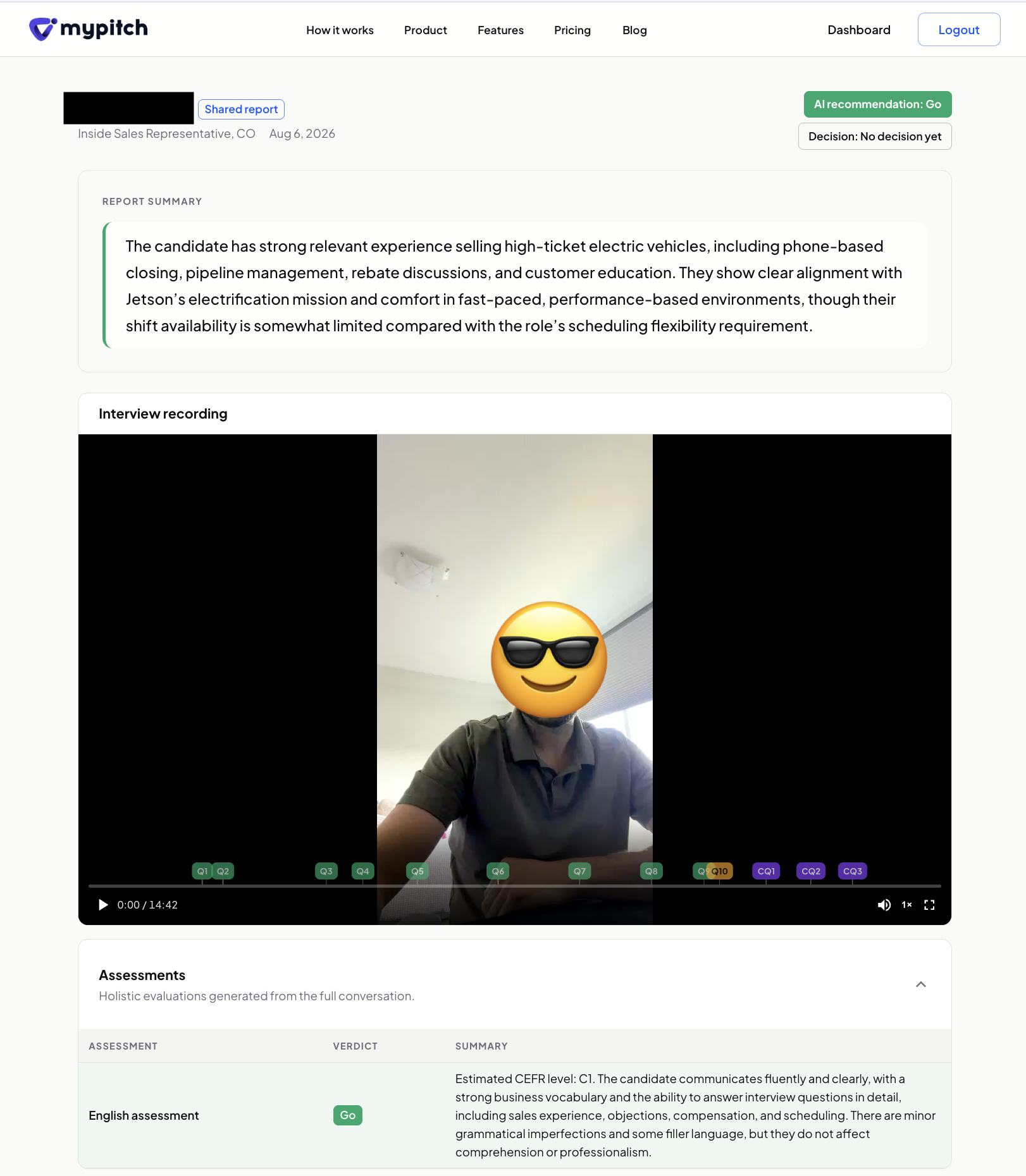
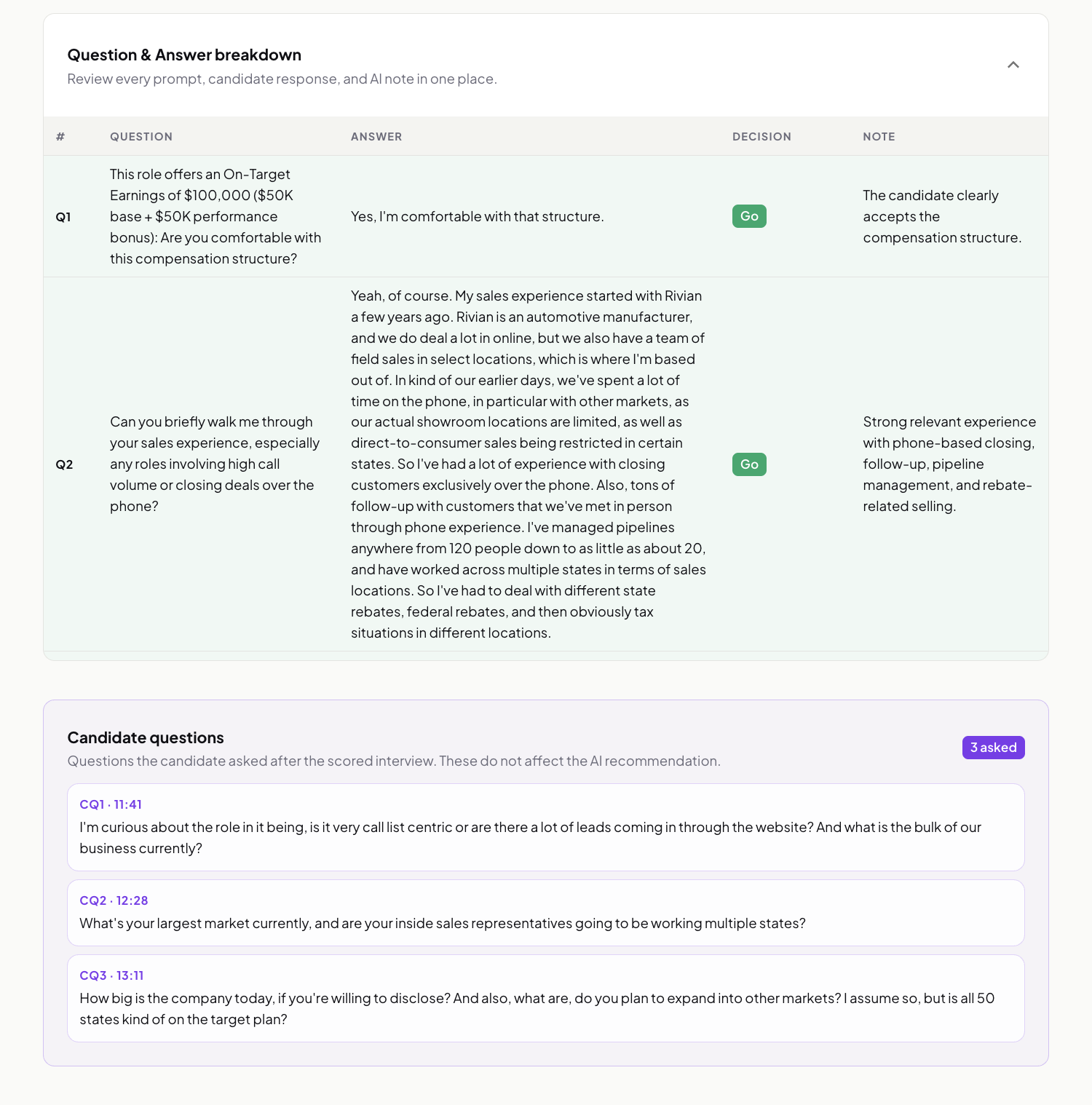
The report should show evidence, gaps, and uncertainty
A recruiter phone screen often compresses a candidate into a note. A better automated screen should expand the review surface.
For each candidate, the hiring team should be able to answer:
- What did the candidate actually say?
- Which questions were answered well?
- Which answers were vague?
- Which required areas were not covered?
- What evidence supports the recommendation?
- What should the next human interviewer verify?
The most useful reports do not pretend every candidate fits neatly into a score. They separate evidence from interpretation.
For example:
| Report signal | Useful interpretation | Recruiter action |
|---|---|---|
| Strong example with specific numbers or customer context | Candidate may have real experience | Move forward or verify in the next round |
| Confident but generic answer | Candidate communicates well, but evidence is thin | Ask for concrete examples later |
| Missing answer or incomplete coverage | The screen did not establish enough evidence | Treat as uncertainty, not automatic rejection |
| Clear mismatch on role basics | Candidate may not fit current role constraints | Review before declining |
| Technical issue during interview | Process issue may have affected performance | Check transcript/recording before judging |
This is where AI candidate screening can be better than a rushed phone screen: it can preserve what happened, not only what someone remembered to write down.
Candidate experience is part of the screening system
Automating a recruiter phone screen creates a new risk: the company may move faster while candidates feel less respected.
That is why candidate experience should be measured inside the workflow.
Greenhouse's 2024 Candidate Experience Report found that many candidates would reapply after rejection if they received feedback after an interview. SHRM has also described candidate feedback surveys as a useful way to understand communication quality and the interview experience. Those findings are broader than AI interviews, but they point to the same operating rule: hiring teams should not infer candidate experience from completion data alone.
For AI interviews, the team should track:
- invite-to-start rate;
- start-to-completion rate;
- technical drop-off;
- candidate feedback rating;
- candidate comments;
- recruiter report-view rate;
- recruiter agreement or override rate;
- progression to human interview.
MyPitch collects anonymous post-interview feedback from candidates. After the interview, candidates can rate the experience from 1 to 5 and leave an optional comment. Recruiters can review that feedback by role and across the company.
That feedback should not become a hiring signal. It should become a process signal. If candidates say a question was confusing, the hiring team can rewrite it. If they report technical friction, the team can inspect the session. If they say the experience was clear, the team has more confidence that speed is not damaging the employer brand.
Compliance and disclosure should be designed into the workflow
AI hiring tools operate in a sensitive category. Rules differ by jurisdiction and use case, so hiring teams should not treat legal risk casually.
New York City's Automated Employment Decision Tools page is one visible example of how notice and transparency have become part of the employment AI conversation. The exact obligations depend on whether a tool falls within the relevant legal definition and how the employer uses it, but the broader lesson is clear: candidate-facing AI should be disclosed, documented, and kept under human review.
For a first-round AI interview workflow, the practical guardrails are:
- tell candidates when AI is part of the process;
- explain what the interview is used for;
- avoid presenting the AI as the final hiring decision-maker;
- keep the recruiter or hiring team responsible for next-step decisions;
- preserve transcript and recording evidence;
- document the criteria used in the screen;
- provide a way to review process quality and candidate feedback.
Greenhouse's 2026 candidate AI interview research also points in the same direction: be upfront about where AI is used, explain what is being evaluated, keep humans visibly involved, and communicate outcomes clearly.
The product message should match the workflow. "AI replaces recruiters" is the wrong story. "AI helps recruiters review more first-round evidence" is the safer and more useful story.
Where automation is a bad fit
Not every role should start with an automated screen.
Be careful when:
- the role is senior, executive, or highly relationship-driven;
- the first conversation must be handled by a founder or specialist;
- hands-on skill, licensing, or physical work sample matters more than communication;
- the team cannot define the evidence it wants from the screen;
- the company is unwilling to disclose AI use to candidates;
- the buyer expects the system to reject candidates automatically with no human review.
For MyPitch, the strongest early fit is not every possible job. It is repeatable, communication-first hiring where a first-round screen is useful but too expensive to run manually at scale.
That includes inside sales, SDR/BDR, appointment setter, customer support, call center, client service, customer coordinator, and staffing agency roles.
The automation test should start there.
How to test first-round screening automation on one role
Do not begin by debating whether AI interviews are good or bad in general. Run a controlled test.
Pick one active role with enough candidate volume. The best first test is usually a role where:
- the team expects at least 20 candidates;
- communication matters;
- the current phone screen is repetitive;
- the recruiter already knows the first-round criteria;
- a hiring manager can review a small batch of reports.
Then run the test in five steps.
1. Define the decision the screen must support
Write one sentence:
"After the first screen, we need to know whether this candidate should speak with the hiring manager."
Then list the evidence needed for that decision. For example, an SDR screen might need communication clarity, motivation, example of handling rejection, basic role understanding, and availability.
2. Turn criteria into questions or focus areas
Do not ask clever interview questions. Ask questions that produce reviewable evidence.
Weak:
"Are you a good communicator?"
Better:
"Tell us about a time you had to explain something difficult to a customer or prospect. What was the situation, and how did you handle it?"
The second question gives the recruiter something to evaluate.
3. Invite a small candidate batch
Start with a controlled group instead of changing the whole funnel. For example, invite 10 to 25 candidates and compare the output with the team's usual phone screen expectations.
4. Review reports with the hiring manager
The recruiter and hiring manager should review:
- the report;
- the transcript;
- the recording;
- the recommendation;
- the evidence behind the recommendation;
- any candidate feedback.
The question is not "Did the AI sound impressive?" The question is "Did this screen give us enough evidence to decide the next step?"
5. Decide whether to expand
Expand only if the test shows healthy signals:
- candidates complete the interview;
- reports are useful;
- recruiters trust the evidence;
- hiring managers agree the shortlist is reasonable;
- candidate feedback does not show major experience problems;
- the process saves real recruiter time.
If one signal is weak, fix the workflow before scaling.
What to measure before replacing recruiter phone screens
The right metrics combine speed, quality, and trust.
| Metric | Why it matters |
|---|---|
| Invite-to-start rate | Shows whether candidates are willing to begin the AI screen |
| Start-to-completion rate | Shows whether the experience is usable enough to finish |
| Time from invite to completed interview | Shows whether scheduling friction has been reduced |
| Report generation success | Shows whether the workflow reliably produces review artifacts |
| Recruiter report-view rate | Shows whether recruiters actually use the output |
| Hiring manager agreement rate | Shows whether the evidence matches decision-maker expectations |
| Candidate feedback rating | Shows whether speed is harming or preserving candidate experience |
| Low-rating reasons | Shows whether issues are technical, communication, role clarity, or trust related |
| Progression to human interview | Shows whether the screen is producing usable shortlists |
These metrics prevent a common automation mistake: celebrating volume while ignoring decision quality.
The point is not to replace a human call with a cheaper digital step. The point is to create a first-round screen that is faster, more consistent, and easier to review.
The practical standard: more candidates, more evidence, same human accountability
Recruiter phone screens are not broken because recruiters are bad at them. They break because synchronous first-round calls do not scale cleanly when hiring volume rises.
The right automation standard is not "Can AI make the decision?"
The right standard is:
"Can we screen more candidates while giving recruiters better evidence and keeping humans accountable for the next step?"
For repeatable communication-first roles, the answer can be yes - if the workflow is designed carefully.
Start with one role. Define the evidence needed. Invite a small candidate batch. Review the reports, transcripts, recordings, and candidate feedback. Then decide whether the automated screen is strong enough to expand.
That is the responsible way to replace recruiter phone screens: not by removing judgment, but by making the first-round evidence easier to collect, compare, and review.
If you want to test this in MyPitch, start with 5 free interviews on one active role. Use the trial to compare three things before scaling: candidate completion, report quality, and recruiter confidence in the evidence.
Related MyPitch resources
- Explore the AI candidate screening workflow.
- Compare the product with other formats on the AI interview software page.
- See pricing for completed interviews.