Structured vs. AI-Led interviews: how to choose the right format
Both formats are live AI interviews. The right choice depends on the evidence your hiring team needs.
MyPitch Team ·
Most first-round interview problems are described as a choice between speed and quality. That is not quite right.
The more useful question is: what kind of evidence does your team need before a person decides what happens next?
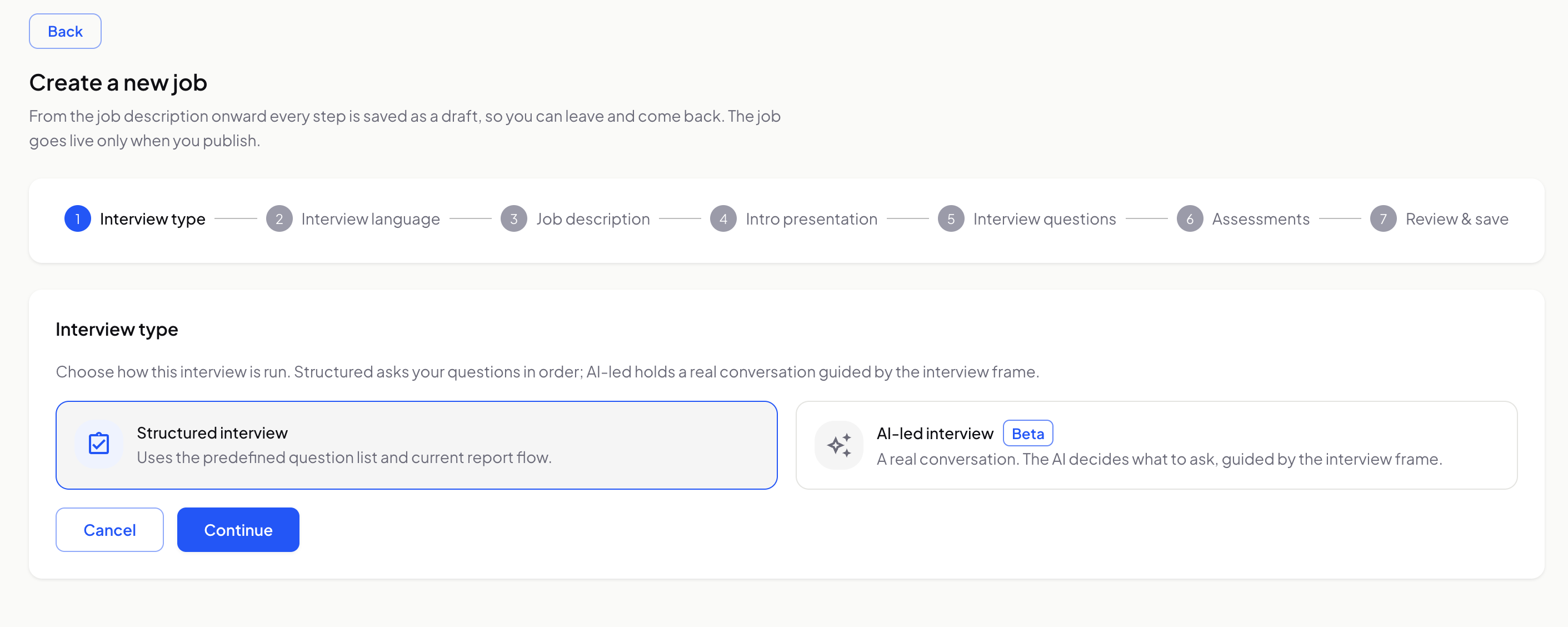
In MyPitch, both structured and AI-led interviews are live, browser-based AI conversations. Candidates receive an invitation, complete device setup and disclosure, speak with an AI interviewer, and produce a recording, transcript, and reviewable report. The difference is not whether a candidate is heard. It is who controls the next question.
In a structured interview, the platform asks the recruiter’s questions in a fixed order and evaluates the answers one by one. In an AI-led interview, the recruiter approves an interview frame, and the AI chooses how to explore it in a real conversation. The platform still controls the time, coverage, report, and safety boundaries.
That distinction changes when each format is useful.
The short answer: use structure for comparability and AI-led conversation for discovery
Choose a structured interview when every candidate should answer the same questions in the same wording. It is the better default for repeated roles with established criteria: a sales development role, a customer-support role, or an operations position with a known first-round screen.
Choose an AI-led interview when the hiring team knows what it needs to learn but does not yet know the best fixed sequence of questions. It is useful for a new or ambiguous role, especially when a founder or functional leader cannot personally conduct every exploratory screen.
In MyPitch, AI-led interviews are currently in beta and run on the OpenAI provider path. Confirm that availability before committing the format to a customer workflow.
AI-led does not mean unstructured. It replaces a question list with a structured plan for the conversation. Structured does not mean robotic. It means the control system protects comparability.
Both modes share the same hiring workflow
The two formats sit in the same MyPitch screening loop:
- A recruiter creates a job and configures the interview.
- Candidates join through an invite or a job link and complete a live AI interview in the browser.
- MyPitch preserves the transcript, recording, and session context.
- A report turns the interview into evidence the recruiter and hiring manager can review.
- The hiring team—not the AI—makes the next hiring decision.
This matters because the format should not create a separate hiring system. The team still needs a defensible decision artifact: what the candidate said, what examples they gave, what was not covered, and what should be checked in a human interview.
The operating model changes at the next question
The table makes the trade-off clear: structured interviews standardise the input; AI-led interviews standardise the objective.
Structured interviews protect the comparison itself
In structured mode, MyPitch owns every spoken question. The listed questions are asked in order and verbatim; the system, not the model, decides when to advance. The result is a report that evaluates each question separately.
That matters when the hiring team wants to compare candidates on a shared baseline. If every candidate is asked how they handled the same customer escalation, or how they would approach the same sales scenario, the team can review differences in evidence rather than differences in what happened to come up in conversation.
This is especially useful when:
- the role is hired repeatedly;
- the team already knows the signals it wants to test;
- several recruiters or hiring managers need a common first-round standard;
- the business needs to audit whether a required question was asked.
But a fixed question list does not automatically create a good interview. Weak questions still produce weak evidence. A structured format works when the team has done the harder upstream work: define what good looks like and write questions that can reveal it.
AI-led interviews protect exploration without giving up the plan
In AI-led mode, the recruiter does not start with a script. They approve an interview frame. In MyPitch, that frame includes an interview goal, three to five focus areas, what each area should establish, private evidence criteria, optional word-for-word must-ask questions, and prohibited topics.
The AI then holds a natural conversation around those objectives. It can ask a candidate to make a broad claim concrete, change the order of topics when the conversation makes that sensible, and avoid spending the whole interview on one answer.
The important point is that the conversation is not left entirely to the model. After a substantive answer, the system records coverage for the relevant focus area and decides the next instruction: pursue the area, move to another one, ask a required verbatim question, open candidate Q&A, or close the interview. Each focus area is capped at three turns, so one topic cannot consume the whole session.
That is the difference between “an AI chats with the candidate” and “a team runs a controlled conversational screen.”
AI-led mode is a strong fit when a team is hiring a role it has not hired before. Imagine a company opening its first partnerships function. The leadership team may know it needs someone who can build a partner channel, select early partners, resolve conflict, and measure commercial impact. It may not know the one perfect question order for every candidate.
The frame makes the decision criteria explicit. The conversation gives the AI room to find useful examples. The report returns to the same focus areas so the team can still compare what was learned.
The report should preserve uncertainty, not hide it
Both formats produce an advisory Go / Doubt / No-Go recommendation, supported by the transcript and recording. Those labels are not an automated hiring decision.
The reporting logic matters most when the conversation is incomplete. In AI-led mode, an area that was never reached is recorded as not covered and receives Doubt, not No-Go. A vague or unsupported claim is also not treated as a positive signal simply because the candidate said it confidently.
This is a practical rule for human review: missing evidence is a reason to investigate, not proof that a person is unsuitable.
The platform also keeps private evidence criteria out of the candidate-facing browser session. Candidates should know the role and the interview format; they should not receive the recruiter’s hidden scoring rubric. The full criteria are available to the report-generation process, where they can support a more useful review artifact.
Use the mode that matches the maturity of the hiring decision
The decision can be reduced to two questions.
1. Do you need every candidate to answer the same question?
If yes, choose structured. It is the better tool when comparability depends on exact wording and sequence.
Example: a support team hiring for a repeatable frontline role may need every candidate to describe how they would handle an upset customer, prioritise multiple tickets, and work through a common scenario. The same prompts make the evidence easier to compare across a large batch.
2. Do you need to explore an objective rather than verify a script?
If yes, choose AI-led. It is the better tool when the team needs depth, clarification, and role-specific follow-up—but can still state the areas that matter.
Example: a company hiring its first operations manager may care about process design, stakeholder alignment, judgement under ambiguity, and examples of improving a broken workflow. Those are clear objectives, but the right follow-up depends on the candidate’s background.
A practical middle ground: preserve non-negotiables, then allow discovery
AI-led mode can include word-for-word must-ask questions. Use them for information that must be covered in every interview, then let the conversation explore the rest of the frame.
This is useful when the team needs both a common baseline and room to understand an unfamiliar candidate story. It is not a reason to add every possible question to the frame. If everything is mandatory, the team has recreated a structured interview with less clarity.
What voice changes in the business of screening
The value of a live voice interview is not that it makes a first screen feel more futuristic. It is that spoken conversation can capture reasoning, examples, hesitation, and follow-up context that a CV or a form cannot.
For the business, this changes the capacity equation. Candidates can complete the interview without calendar coordination, while recruiters review a report, transcript, and recording when they are ready. The workflow can reduce scheduling loops and create a more consistent first-pass record—but the actual time saved and hiring impact should be measured in each customer’s process, not assumed.
The relevant metrics are practical:
- invite-to-completion rate;
- time from interview end to report ready;
- report-view rate;
- recruiter agreement or override rate on recommendations;
- progression from the screen to a human interview;
- candidate feedback and technical drop-off.
Those measures reveal whether a voice workflow is creating useful evidence, not merely completing more sessions.
Start with one role and one evidence standard
Do not decide between the formats as an abstract product preference. Start with a real open role.
- Write down the decision the first screen must support.
- List the evidence a recruiter needs to make that decision responsibly.
- Choose structured mode if the evidence comes from the same known questions for every person.
- Choose AI-led mode if the evidence comes from exploring defined objectives in different candidate stories.
- Run a small candidate batch, then review the reports with the recruiter and hiring manager.
- Adjust the questions or frame based on the evidence the team actually used.
The choice is not between a rigid interview and an uncontrolled AI conversation. It is between two ways of making a first-round decision more deliberate.
Use structured interviews when fairness and comparability depend on an identical path. Use AI-led interviews when the team needs a guided conversation to discover what it cannot learn from a fixed script. In both cases, the standard should be the same: faster screening is only valuable when it gives humans better evidence for the next decision.
Decision layerStructured interviewAI-led interviewRecruiter preparesAn ordered list of questions, with optional evaluation guidanceAn interview frame: goal, role/company summaries, focus areas, evidence criteria, optional must-ask questions, and prohibited topicsNext questionThe platform asks the next listed question verbatimThe AI chooses wording and sequence to pursue the current objectiveFollow-upThe platform applies turn rules before moving onThe AI can probe for a concrete example, then moves when enough evidence is collectedConsistencyIdentical questions create direct answer-to-answer comparisonIdentical focus areas create consistent decision criteria, while the conversation can varyReport unitOne analysis row per questionOne analysis row per focus areaBest fitHigh-volume or mature roles with stable screening criteriaNew, senior, specialised, or ambiguous roles where discovery matters
Related MyPitch resources
- Review the full AI interview software workflow.
- See what recruiters receive in a sample candidate report.
- Understand the human-review controls in responsible AI screening.