Structured Interview Software: Questions, Scorecards, and AI Follow-Ups
Compare structured interview software by questions, scorecards, AI follow-ups, and source evidence. Includes a support-role example and buyer checklist.
MyPitch Team ·
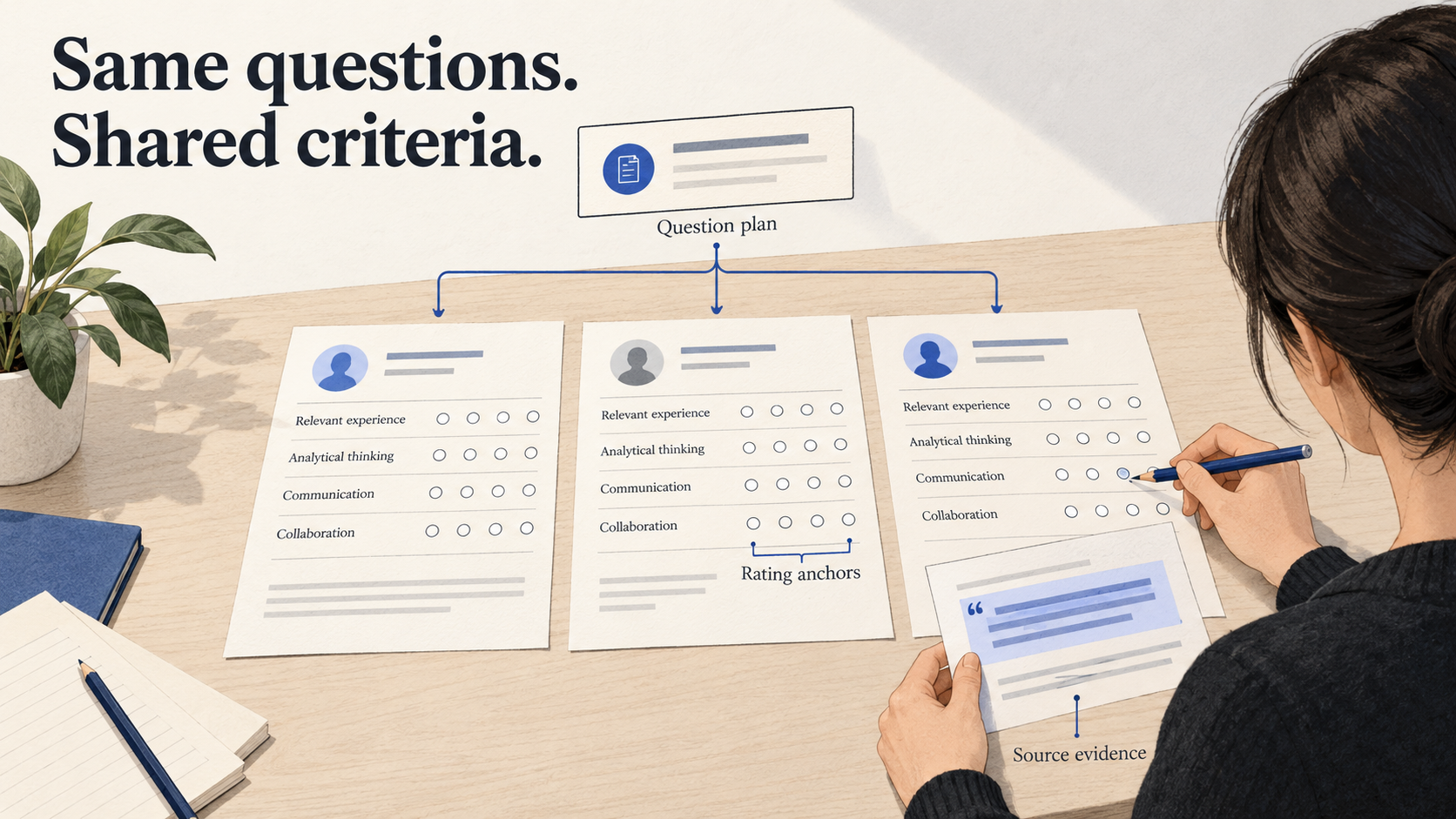
AI-generated editorial illustration. The sheets explain a method; they are not a product scorecard or a validated assessment.
Two candidates receive the same question. One interviewer accepts the first answer. Another asks three clarifying questions, supplies an example, and gives the candidate time to try again. Both interviewers submit a score of four.
The numbers look comparable. The opportunities to produce evidence were different.
Good structured interview software helps a team control that problem. It should make the question plan, evaluation criteria, follow-up policy, and source material clear enough that two reviewers can explain why they reached their conclusions.
Buy for a repeatable evaluation process, not simply a form with ratings. AI can help conduct or document the conversation, but its presence does not establish that the interview is structured.
Structure includes the questions and the standard for a good answer
The U.S. Office of Personnel Management describes structured interviews as using predetermined questions, a consistent order, and common rating standards. Its more detailed guidance also distinguishes degrees of structure, including constraints on follow-up questions. Sources: OPM overview, OPM assessment guidance.
For a buying decision, that gives you three separate controls to inspect:
- Elicitation: what the candidate is asked, including clarification rules.
- Evaluation: what evidence satisfies the criterion and how missing evidence is handled.
- Review: how a person checks the answer behind the rating.
A platform can be strong at one and weak at another. It may enforce a question list but offer only vague ratings. It may generate an excellent summary from a conversation that never covered an essential skill.
Compare the software by where it enters the interview
“Structured interview software” describes several workflows. Shortlist the category before comparing features.
| Workflow | Who asks the questions? | What to inspect in a demonstration |
|---|---|---|
| Interview kits inside an ATS | A human interviewer | Shared criteria, assigned questions, independent feedback, and access to submitted scorecards |
| One-way video interviews | The prepared question sequence | Question order, preparation and answer limits, retake settings, and how reviewers assess responses |
| AI-assisted notes for a human interview | A human, supported by a recording and notes tool | Whether notes map to your criteria and whether reviewers can verify them |
| AI-conducted interviews | An AI interviewer within the configured mode | Question control, follow-up boundaries, coverage, and how recommendations relate to source answers |
For example, Greenhouse documents predetermined scorecard criteria and interview kits containing questions and evaluation material. Hireflix documents one-way questions, answer-time settings, retakes, and team review. These solve different operational problems even though either can support a structured process. Sources: Greenhouse scorecards, Greenhouse interview kits, Hireflix features.
Ask vendors to demonstrate six controls
Bring one real role specification and a small set of internal test answers to the demonstration. A prepared demo candidate rarely exposes the difficult cases.
| Control | Ask the vendor to show | A useful acceptance criterion |
|---|---|---|
| Question plan | How the core questions are approved and delivered | A reviewer can see which required questions were actually asked |
| Rating anchors | How your team defines weak, adequate, and strong evidence | Ratings refer to observable job-related behavior, not adjectives such as “impressive” |
| Follow-up policy | What happens when an answer is incomplete | Clarification has explicit boundaries and does not quietly change the assessed skill |
| Missing evidence | An answer that is absent, interrupted, or unusable | Reviewers can distinguish lack of evidence from evidence of weak performance |
| Source verification | A summary claim traced to an answer | The original answer is accessible without reconstructing the whole interview |
| Human review | A disagreement with the suggested assessment | A person can document a reasoned next step rather than accept the score as final |
These are evaluation requirements, not a claim that every named product implements each control. Check the exact edition and workflow you will use.
A support-role example makes the criteria testable
The following is a fictional teaching example for a customer-support role. It is not a MyPitch candidate, a validated selection instrument, or a recommended hiring cutoff.
Suppose the first screen needs evidence of issue diagnosis and escalation judgment. Replace a broad question such as “Are you good with customers?” with a specific situation:
Tell me about a time a customer reported a problem you could not reproduce. What did you check, what did you tell the customer, and what happened next?
Before using it, agree on what different answers would demonstrate.
| Criterion | 1 — limited evidence | 3 — adequate evidence | 5 — strong evidence |
|---|---|---|---|
| Issue diagnosis | Describes guessing or immediately passing the issue on, without investigating | Explains relevant checks and records the findings | Tests plausible causes in a clear sequence, uses results to narrow the problem, and explains remaining uncertainty |
| Escalation judgment | Cannot explain when or why another team should be involved | Identifies a sensible escalation point and gives the receiving team context | Balances urgency and customer impact, transfers useful evidence, and maintains clear ownership of the next update |
Add a separate not enough evidence state to the review process. Do not automatically turn a lost audio segment, an unasked question, or an interrupted interview into the lowest skill rating.
Now compare two invented responses:
Response A: “I sent it to engineering because it was technical. They fixed it.”
Response B: “I checked the account and recent changes, asked for the exact error, and tried to reproduce it. I sent engineering the steps and logs, then told the customer when I would update them.”
Response B contains more assessable evidence for these criteria. Response A does not tell you enough to conclude that the person never performs those actions. The next step could be a predefined probe: “What did you check before escalating?”
This example is useful in a software demo because it tests more than transcription. Does the output preserve what was said? Does it distinguish an omission from a negative finding? Can a second reviewer reach the relevant answer quickly?
AI follow-ups require a policy, not just a toggle
An AI-generated follow-up can clarify an ambiguous answer. It can also change the interview's difficulty or coach a candidate toward a better response.
For the support example, “What did you check before escalating?” asks for missing context. “Did you check the logs and recent account changes?” introduces possible actions. Those prompts do not create the same opportunity to demonstrate independent reasoning.
One practical policy is to define core questions, approved neutral probes, and conditions for using them. Review actual interview coverage during the pilot. If a process needs tightly standardized questioning, test whether the software can honor that constraint instead of assuming that an adaptive conversation is equivalent.
MyPitch's current setup offers Structured interview and AI-led interview, with the latter marked Beta. The interface describes the first as using a predefined list and the second as allowing AI to choose questions within a frame.
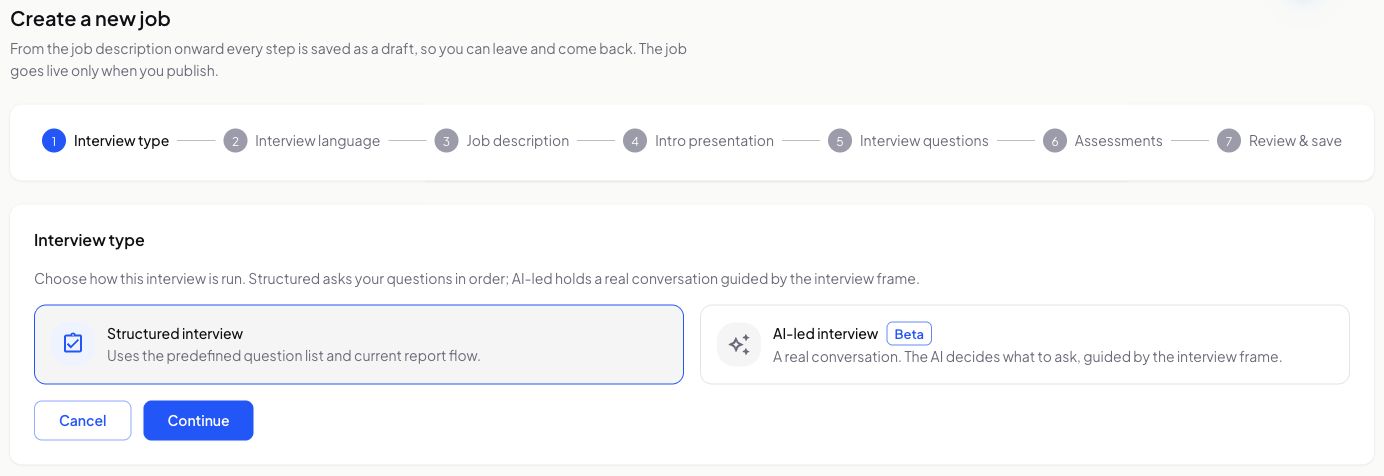
Actual application screenshot, October 21, 2026. The crop excludes account information. The labels demonstrate mode selection; they do not establish that the two modes have identical standardization.
This distinction matters for buyers. A fixed-question mode is a more direct starting point when question comparability is the priority. An adaptive mode should be evaluated for useful coverage and bounded clarification. In either case, inspect what happened in the interview rather than relying only on the setup label. MyPitch's public format explanation.
Test the process with disagreements and failures
Use a small internal pilot before relying on the workflow with applicants. A practical first pass is six clearly labeled test interviews: two clear answers, two partial answers, one contradictory answer, and one interrupted session. This is a workflow check, not statistical validation.
Ask two reviewers to assess them independently using the same criteria. Compare where their judgments differ and identify the source of the disagreement: the answer, the criterion, the transcription, or the summary.
Track measures that explain the work:
- Required-question coverage, rather than interview length alone.
- Unsupported summary claims found during source checks.
- Time needed to verify a disputed assessment.
- Cases where an interruption is confused with weak performance.
- Reviewer disagreement that remains after checking the source.
If criteria are vague, revise the criteria. If source context is hard to retrieve, investigate the software workflow. If the platform adds leading probes, change the mode or the policy. A higher average score would not resolve any of these problems.
Choose the smallest system that preserves the evidence you need
An existing ATS with well-designed interview kits may be enough when humans can conduct every call. One-way video can help when scheduling is the constraint. An AI interviewer becomes relevant when the team needs first screens conducted without a recruiter attending each one.
MyPitch is an example of that last workflow. Its candidate report is designed to keep the recommendation, transcript, and recording available for review. MyPitch publishes this guide; its inclusion illustrates the workflow rather than a universal product ranking.
If that is your bottleneck, test five free interviews against one approved question plan. The question to answer is whether another reviewer can understand and verify the evidence well enough to plan the next human conversation.
Continue reading
- Structured vs. AI-led interviews: choosing the format
- Candidate feedback: what hiring teams should measure
- Responsible AI screening
Source notes
Sources were checked on October 21, 2026. OPM supports the explanation of structured questioning and shared rating standards. Vendor documentation supports the named examples, not a claim that a particular implementation is validated, unbiased, or suitable for every role.
The support-role rubric, responses, follow-up examples, and pilot design are original editorial teaching material. They require adaptation and review for an actual role. No private candidate answers, identities, recordings, or performance figures are reproduced.